Feierabend · the end of the working day
Art | Canvas
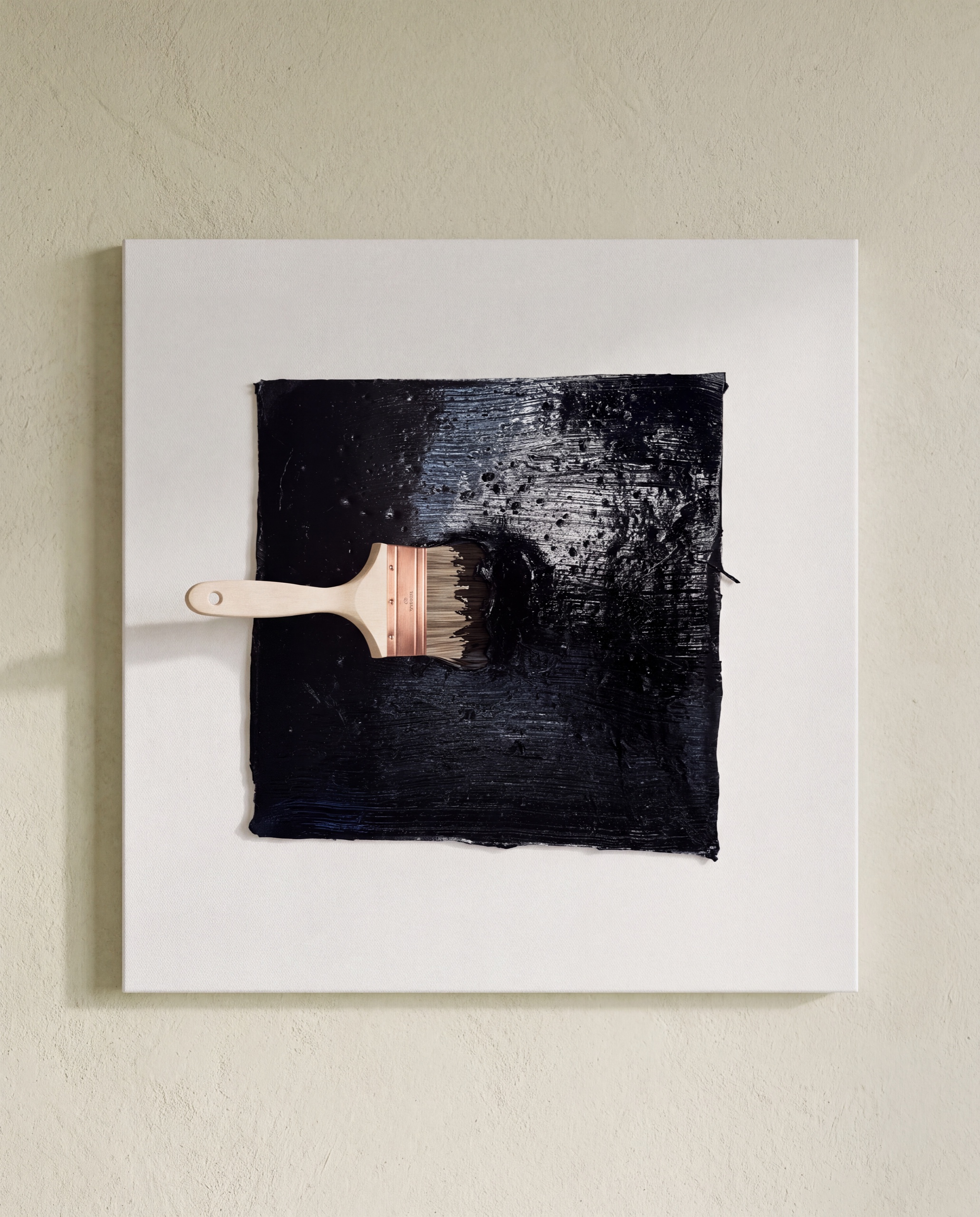
A black square built thick on sponge at the centre of bare canvas, and the brush that made it left pushed into the paint, its handle standing out as if the hand had just let go.
- Medium
- black paint laid heavy over sponge on cotton duck, a house-painter's brush
- Category
- Art | Canvas
- Year
- 2026
Feierabend
the end of the working day
Feierabend is the German word for the end of the working day: the hour you put the tool down and go home. On a large square of bare white canvas sits a black square, built up first with sponge so it stands thick off the cloth, then loaded with black paint until it is glossy and heavy. A wide house-painter's brush is pushed into the wet black. Its bristles are buried, and its wooden handle and copper ferrule stand out from the surface at an angle, as if the hand had just let go.
The brush was never cleaned. It was left in the work, and the paint set around it. Every made thing hides the labour that made it: the tool is washed and put away, the hand leaves no mark, and the finished surface pretends it arrived on its own. Here the tool stays, because the labour is the subject. The black square is the famous zero of modern painting, the picture that was meant to be the end of pictures, and this one has a worker's brush stuck in it. From the side the square stands off the canvas as a slab, and the handle leans out of it like a post left in wet ground.
The brush where it was left; the square from the side.
It is about the moment someone stops: the end of a shift, or the day the work finally takes more than it gives back. Either way the brush stays where it was dropped. It hangs alone, with room around it, so the white canvas does the work of the white room and the black square is the only event in it. The elevation gives the square and the brush their positions on the canvas, nothing more.
Hung on its own, and the elevation.
The tool stays in the work.
Index
01
02
03
04
05