Abfall · aesthetic waste
Art | Panel
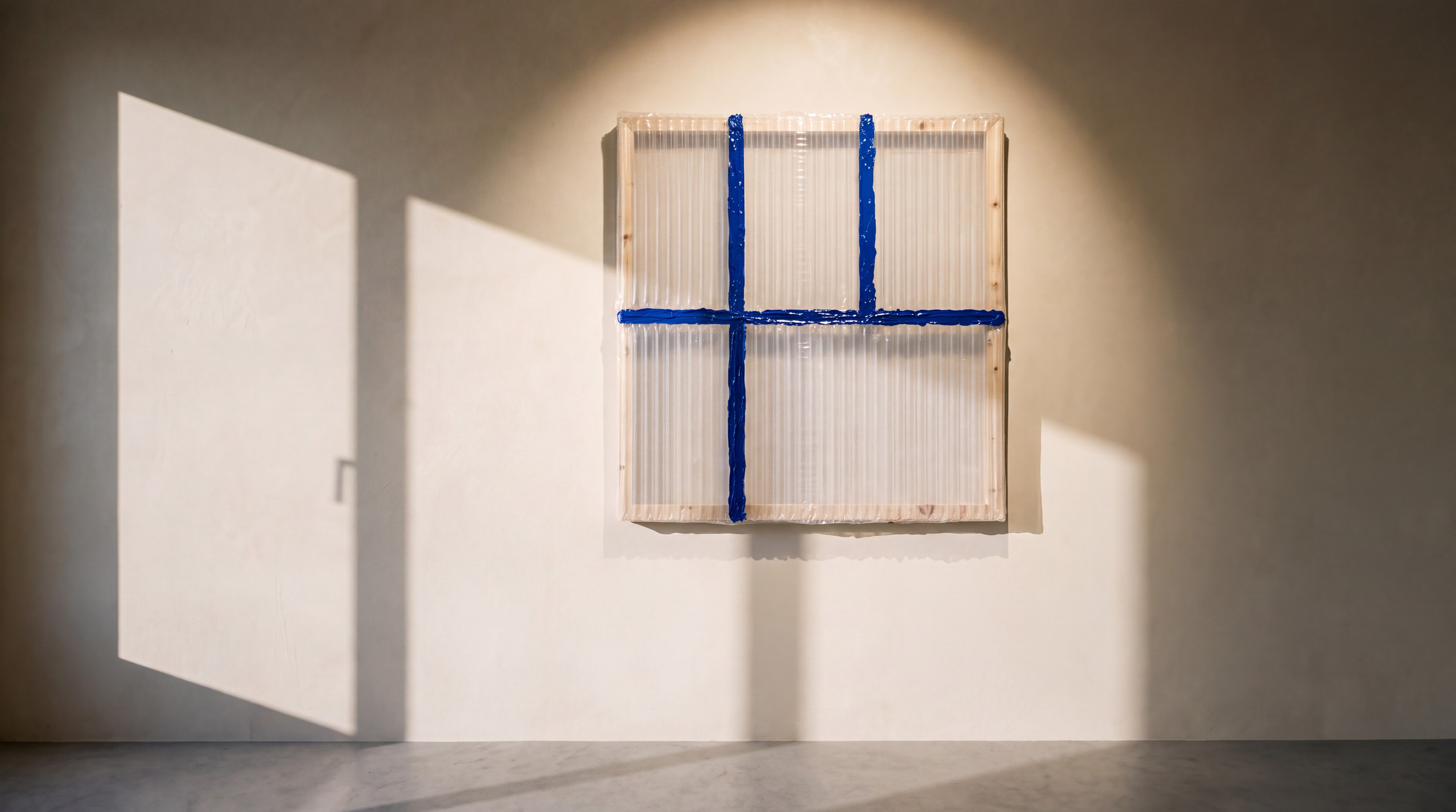
Packaging film, the material every delivery arrives in and nobody looks at, stretched over a bare frame as the canvas. Three knife-laid cobalt bars cross it: a window made of waste.
- Medium
- air-column packaging film, raw softwood, cobalt paste
- Category
- Art | Panel
- Year
- 2024
Abfall
aesthetic waste
Every object that reaches a door arrives wrapped, and the film around it does its work for a few days and is thrown away without anyone looking at it. Abfall takes that film as its canvas. Clear air-column packaging, inflated and kept whole, is wrapped all the way round a bare frame of raw softwood, with the valve beading folding over the top and bottom battens, so each column runs the full height of the square from edge to edge. The panel is three feet square. Nothing on it was made to be looked at, which is why we looked.
A stretcher is normally hidden behind its painting. Here the four softwood battens stay bare, knots and all, and show through the film from the front, because the support is part of the picture. Over the machine grid of the columns we laid a second grid by hand. Thick cobalt paste is pressed on with a knife, crushing the air columns beneath it and cresting where it runs onto the timber. Three runs divide the square: one the full width, one the full height, and a third that drops from the top edge and stops at the horizontal. With its frame and its three bars, the panel reads as a window made of waste.
From above, and the crest where the paste meets the batten.
The paste is never smoothed. Torn edges, knife partings and pulled horns stay as they were made, so that against the regularity of the film the blue is the only thing on the panel that was clearly done by a person. The film is translucent, and that is the reason for it: the canvas holds light instead of stopping it. Whatever stands behind the panel becomes part of the picture, and in sun the columns throw a striped shadow onto the wall, so the piece draws a second image of itself.
Nothing on the panel is precious. What makes it a work is attention: where the paint goes, what stays bare, and the decision to show the frame. It hangs where a window would, on a plain wall, and it is at its best with light behind it, where the columns glow and the bars go dark. Seen in a gallery it is quiet. Seen against a window it is a drawing in blue on a sheet of light.
On a gallery wall, and backlit against a window.
The elevation: three bars across thirty-six columns.
Index
01
02
03
04
05
06
07
08
09